
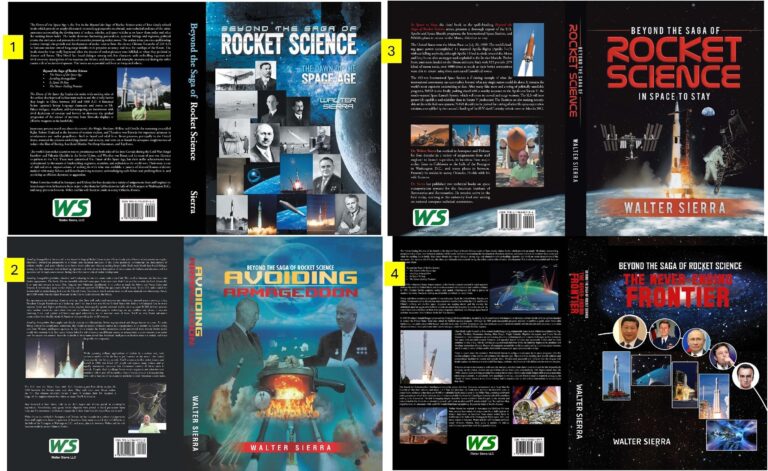
My four-book series Beyond the Saga of Rocket Science, written under the pseudonym Walter Sierra, provides an amply-illustrated, overarching perspective to a broad, non-technical audience of the entire panorama surrounding thedevelopment of rockets, missiles, and space vehicles as we know them today and what the exciting future holds. The books are sequential and form an integrated whole: (1) The Dawn of the Space Age; (2) Avoiding Armageddon; (3) In Space ToStay; and (4) The Never-Ending Frontier.
Beyond the Saga of Rocket Science is a must-read for anyone interested in space, science, and the people who have shaped our understanding of the universe. It will attract both casual readers and those with a deep interest in the field ofrocket science. Plentiful figures, illustrations, and photos serve to clearly explain and simplify the complex engineering behind rockets in simple terms anyone can understand. The books should be read in sequential order because each of the 19chapters builds on the next to explain the basics of rockets while engaging the reader with intriguing stories and dialogue between characters– who are real—takes you on a fascinating journey into our space past. You’ll experience what rocketpioneers had to go through to develop today’s rockets, missiles, and space vehicles. In bringing to life the drama and complex interplay among scientists, engineers, and politicians that gave birth to the launch vehicles and spacecraft we take forgranted today. The last book—The Never-Ending Frontier—takes you inside today’s burgeoning commercial space efforts (mostly in the United States) and the latest government space programs and launch vehicles worldwide. You’ll learn why the“death” of rocket science as we know it today is not that far away, and what is most likely to replace rockets as we know them. You’ll be taken way beyond rocket science with thought-provoking and well-researched chapters on superintelligentcomputers; far-out propulsion systems that are technically feasible; the search for extraterrestrial intelligence (where are they?); humanity’s accelerating evolution (where is it going, and how long will it take?); cosmology (how many universes arethere?; is space infinite?); physics (is a theory of everything possible?).
The highly informative The Dawn of the Space Age begins withexciting tales of the earliest developers of rudimentary rocketsand the deadly battles they fought in China between 200 and1600 A.D. A historical fiction approach brings long-agocharacters and events to life. The tremendous achievements ofthe Wright Brothers – Wilbur and Orville – in the early 1900sserve as a useful backdrop for showcasing the difficultiesinvolved in developing completely new technologies forpractical use. The ingenious Dr. Robert Goddard, widelyacknowledged as the inventor of the modern rocket, developeda sound theory in the 1910s and conducted pioneering flighttests in the 1920s and 1930s, while overcoming many failures.World War II gave the biggest impetus ever to advancing rocketscience and related technologies. The book describes how theGerman V2, Soviet Soyuz, and American Corporal rocketspaved the way for the design, fabrication, and operation ofmore refined, sophisticated second and third-generationmissile systems that followed.
In the ensuing decades many unsung space heroes on bothsides of the Iron Curtain matured the field to where it is today.Led by the indomitable Sergei Korolyov, the Soviet Unioncaptured an early lead over their archrival superpower duringthe Cold War and achieved an embarrassing (for the UnitedStates) plethora of civilian space firsts. In the U.S., Dr. Wernhervon Braun led the American space program during the crucialdecades of the 1950s-1960s. He did more than anyone else inAmerica to advance missiles, rockets, spaceflight; and madethe manned landings on the moon possible. Von Braun ledAmerica’s race to the Moon, including the precursor MercuryProgram, the Gemini Program, and finally the Apollo Programwhich landed 12 men on the Moon and returned over 835pounds (379 kg) of moon rocks to the Earth.
Avoiding Armageddon provides a detailed and fascinatingbehind-the-scenes look at the Cold War conflict between theAmerican and Soviet superpowers. Avoiding Armageddon describes the herculean efforts expended by the United Statesand the Soviet Union to best each other in rocketry during theCold War years, interspersed with attention–grabbing accountsof the engaging personalities involved. Both countries stood ona precarious knife-edge as each sought supremacy in nuclearweapons, waiting for the other to strike before mounting adevastating counterstrike. The book clearly explains theweaponry developed by both superpowers during an escalatingnuclear arms race, how the Soviets managed to pull ahead atfirst, and how they overcame unbelievable handicaps andheart-rending space disasters to come within a hair’s breadthof winning the Space Race against their implacable foe.
It lucidly describes the effects of nuclear weapons and howthey work. The Soviets achieved a startling number of spacefirsts (first satellite, first man and woman to orbit the Earth, firstprobes to reach Mars and Venus, first Space Station, morepowerful ICBMs. The USSR assumed a commanding lead in theSpace Race between both countries; however, the bookdescribes how and why despite appearances it was actually theUnited States that was ahead. Avoiding Armageddon disentangles and clearly explains the labyrinthine Sovietorganizational and design bureau structure. Although the U.S.won the Moon Race, the Soviets came very close with their ownMoon rocket, the N1.
Whereas Avoiding Armageddon reveals the ColdWar conflict and ensuing Space Race from theSoviet Union’s point of view, In Space To Staydescribes this engrossing story from the Americanperspective. The United States won the Moon Raceon July 20, 1969. The world’s leading space poweraccomplished 11 manned Apollo flights (Apollo 7–17) without killing anybody, although Apollo 13 hadto circle around the Moon and limp home after anoxygen tank exploded in the Service Module. Twelvebrave astronauts landed on the Moon and cameback with 835 pounds (379 kilos) of moon rocks,over 1000 times as much as their Soviet competitorswere able to return using three automated Lunokhodrovers.
The 485-ton International Space Station is a shiningexample of what the international community canaccomplish, beyond what any single nation could doalone. It remains the world’s most expensiveundertaking to date. After many false starts and astring of politically unsellable programs, NASA isalso finally pushing ahead with a worthy successorto the Apollo-era Saturn V: the much-vaunted SpaceLaunch System, which will come in crewed andcargo versions. The SLS will have greater liftcapability and reliability than its Saturn Vpredecessor. The Russians are also makingremarkable strides with their new systems. NASAshould also be praised for a string of scientific spaceexploration missions, exemplified by the successfullanding of the SUV-sized Curiosity robotic rover onMars in 2012.
The Never-Ending Frontier is the flagship bookof the Beyond the Saga of Rocket Scienceseries and culminates a thorough exposé of theentire panorama surrounding the developmentof rockets, missiles, and space vehicles as weknow them today and what the exciting futureholds. It describes today’s space programsbeing carried out by the spacefaring nations ofthe world. The book also explains the world’sballistic missile defense programs, exemplifiedby President Ronald Reagan’s StrategicDefense Initiative (the “Star Wars” Program)and its downscaling to the U.S. ballistic missiledefense system that is deployed today.
This ground-breaking book explains how andwhy the burgeoning commercial space sectorpromises to “democratize” routine spaceaccess and make space flight affordable for theordinary citizen in the coming decades. Itreveals that rocket science is long overdue for acomplete breakthrough, presaging the “death”of rocket science as we know it today, and itsreplacement by field effects interactions orsomething to that effect that will require nopropellants or visible means of propulsion aswe know them today. Finally, The Never-Ending Frontier takes you on a mind-bogglingtrip to tomorrow, where humans will begin toexplore the cosmos and more than likely wewill find out that intelligent life is commonthroughout the universe.